
Domestic Violence: Not always what it seems

v4-Pistorius-gun

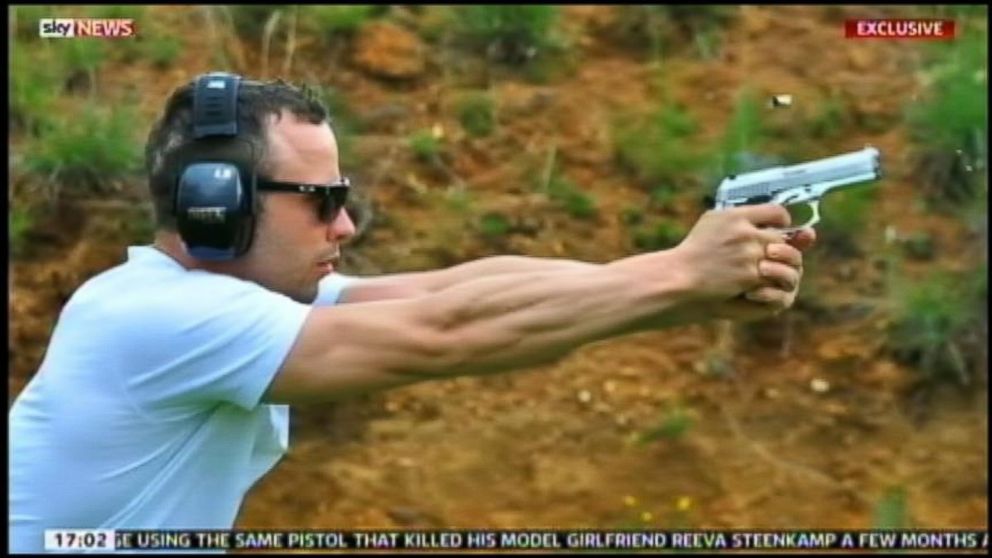
I’ve been following the Oscar Pistorius case recently. My own theory (all pure conjecture of course) is that they had a row, Reeva threatened to leave him, he got mad and became aggressive, so she shut herself in the toilet, refusing to come out; he then got even more mad, grabbed his gun and fired four shots through the toilet door. The rest, as they say, is history.

While following the case I happened to read a recent news story about a woman, Linda Cooney, who was acquitted of murder after killing her ex-husband in Florida 20 years ago but is just about to stand trial for shooting her son with the very same gun she used to kill her husband. Ms. Clooney claimed she shot her ex-husband in self-defense when he attacked her with a kitchen knife. She is now claiming the same motive for the shooting of her son, who she claims punched her. Ironically, it is this son who, when just 11 years old, provided crucial evidence leading to her acquittal by testifying that his father had a shiny object in his hand, despite originally telling investigators that his hands were empty. The son may now be living to regret that decision; the recent shooting left him paralyzed.

A widely-cited study of spousal murders in the US found that wives who kill their husbands were acquitted in 13% of the cases reviewed, while husbands who kill their wives were acquitted in only 1% of cases (the study didn’t include boyfriends and girlfriends, but it still doesn’t look too good for Oscar). The study also revealed that women kill husbands almost as often as men kill wives (women account for over 40% of defendants) but that they tend to serve shorter sentences than men when convicted of murder.

Of course, murder is the ultimate level of domestic violence and self-defense may provide valid justification in some cases; at least, it is much more likely to be successful than Oscar’s dubious claim of mistaken identity. In the vast majority of cases it is women who have been acquitted on the basis of self-defense. However, a landmark case recently took place in Australia when Phillip Bracken was found not guilty of murdering his de facto wife, Helen Curtis, despite being captured on CCTV shooting her in the head with a gun. The jury accepted his claim of self-defense after being told how he had regularly been beaten and abused by his partner.

Yes, although rarer than the other way round, domestic violence does take place against men. A recent study in the UK found that more than 40% of domestic violence victims are male. This shows that the traditional female victim/male perpetrator view of domestic violence is a gross simplification. Of course, the statistics show that women account for over half of domestic violence victims and over half of spousal murder victims; the difference is that domestic violence against men remains a taboo subject.

Joe, the main protagonist in Indelible Scars, is subjected to numerous verbal and physical attacks from his girlfriend, Claire, as illustrated by the opening of the novel:

‘Why are you so evil?’ she screamed.

As he turned, he glimpsed the ascending arc of her arm but was unable to move, caught in one-sided super-slow motion. The wooden rolling pin cracked against his skull. He clasped his hands to his head and fell back against the door, the blood’s dampness warm on his face and hands.

‘Stop bleeding on my clean floor!’ she berated him. ‘Get up and wash your face.’

He forced himself upright and noted with surprise that he could see stars spinning round his head. He had thought that only happened in cartoons. Shaking, he turned on the cold water and leant over the sink, letting the water gush over his forehead. He half-turned to see where she was: she was right behind him still brandishing the rolling pin.

‘Wash the blood off; you’re bleeding everywhere!’ The rage in her eyes told him not to argue.

He turned back to the sink, and then: whack! She hit him hard in the small of the back. He roared in pain. Fumbling, he grabbed a pile of kitchen tissue from beside the draining board, pressed it against his forehead and made for the back door.

‘Where do you think you’re going now?’ she snarled at him.

‘Hospital,’ he groaned.

‘Get back in here this second!’ She edged towards him gripping today’s chosen weapon.

‘I can’t. I have to go. Just let me go.’

‘Don’t you dare! Come here. I’ll fix it,’ she demanded.

But he was already gone, racing out into the street, the blood-soaked tissue clasped in desperation against his head.

I chose to put Joe in such a situation to highlight the fact that men are also victims of domestic violence and because I wanted to explore the complexities of why someone might stay in an abusive relationship. It’s so easy to simplify or criticize from the outside. For example, when a woman is regularly beaten by her husband but forgives him every time, it is perfectly natural to ask: why doesn’t she just leave him? And of course, she should. Clearly, not all abusive relationships involve violence; persistent emotional abuse, with little or no respite, can be just as damaging. So why do people stay in abusive relationships? I believe that there are many possible reasons: pride (i.e. not wanting to admit that you made a poor choice in choosing a partner or that your relationship has failed); low self-esteem or guilt (believing you deserve to be treated badly in some way); fear of the unknown or of being alone; and pity for the other person and wanting to help fix them. In most cases it is probably a combination of several of the above.

For a male victim of domestic violence it is especially difficult to share with other people and admit what’s really happening in a relationship.  This is due, in part, to the macho psyche – after all, it is hard to admit that a woman much smaller than you has inflicted physical harm – but it is also due to the response of society. There is a valid fear of not being taken seriously. Popular culture often downplays violence against men and there is a tendency to excuse female excesses in behaviour: ‘He must have done something really bad to make her that mad!’ The police, and even healthcare professionals, are often no better. The following encounter between Joe and a female nurse illustrates this point:

He walked into the glare of the Accident and Emergency room, relieved to escape the bitter winter’s night. The room was almost full but there were a few empty chairs in the waiting area.

‘Can I help you?’ the receptionist asked when he reached the desk.

‘Yes, I have a wound on the back of my head,’ he answered.

She looked up at him for the first time, the corners of her mouth turning down as she saw the blood trickling down his neck.

‘Please help yourself,’ she said pushing a tissue box across the desktop with the tips of her manicured fingernails. ‘Your name please?’

‘Joe Gower,’ he replied.

‘Please take a seat, Mr Gower. You will be called when it’s your turn.’

  He selected a seat at the back of the room and mopped the back of his head and neck with a bundle of tissue paper. Within seconds it became drenched and he applied another handful.

  When his name was called he was ushered into a windowless consulting room where a female nurse asked him to take a seat.

‘So what happened to you?’ she asked, eyeing the bloody tissue in his hand.

He contemplated whether or not to invent an elaborate lie but didn’t have the energy to think of anything.

‘My girlfriend threw a coffee cup at my head,’ he answered.

‘Oh dear,’ she responded, failing to suppress a thin smile. ‘I hope it wasn’t your best china!’

He shifted in the chair, responding to an inner anger, but said nothing. It was a tasteless joke and he couldn’t help thinking that she would never say such a thing if a woman claimed her boyfriend had done the same, and yet he didn’t have the stomach for another confrontation.

Eventually, in most (but by no means all) unhealthy relationships the person on the receiving end realizes that enough is enough and extracts themselves from the partnership before things escalate to the level where someone’s life is at risk. Perhaps the most useful step to help make a decision is to ask yourself: do I really deserve to be treated like this? When the answer is no, the solution is obvious. It can, however, take a surprisingly long time to ask the right question and sadly, for some people, events spiral out of control before they get the chance.

We may never know the truth concerning what happened between Oscar and Reeva and I may well be completely wrong. All I know is that all victims of domestic violence, whether female or male, deserve to be treated with equal respect and deserve equal justice. I hope that Reeva Steenkamp and her family get the justice they deserve. May she rest in peace.

Charity: Doing good or feeling good?

It is in giving that we receive.

I have just returned home from Burundi where I encountered a rather strange Belgian woman working for a local charity. We met at a health centre high in the hills south of Bujumbura, hemmed in by steep terraced slopes dotted with tin-roofed dwellings and lonely patches of trees. I extended my hand and greeted her in my best schoolboy French: ‘Bonjour. Je m’appelle Pete.’ She took my hand in a limp, damp handshake without uttering a word. The nun in charge of the health centre welcomed us all and explained the challenges they faced concerning inadequate water supplies, her flowing white habit flapping in the wind. A schoolgirl of 10 or 11 described her daily routine of walking a round trip of 4 kilometres to collect water, unaware of the incongruity of Justin Bieber smirking up from her soiled t-shirt. The nameless Belgian was a tall, broad women who seemed as uncomfortable in her frame as she was with other people. She listened to the conversations unsmiling, showing no reaction, all the time clutching a large plastic bag to her chest. Once inside the health centre she began to surreptitiously extract items from the bag and hand them one-by-one to the nun: several pairs of plastic slippers; some bandages; a packet of pills. The nun received them graciously, expressing her gratitude.

Before leaving, the woman approached the huddle of children outside the health centre to hand them some sweets. They jumped up and down laughing and screaming, trying to grab the precious parcels of pleasure. At once, the woman’s face lit up – as if someone had flicked a switch. She ran to the vehicle to fetch her camera, all the time beaming. She returned, her smile wider than ever, transformed: almost reborn. Although I’m sure that the gifts were genuinely appreciated, I couldn’t help wondering who had received more. The entire contents of the bag could not have cost her more than $20.

This experience reminded me of another encounter a few years ago with an American school teacher in South Africa. We happened to be visiting a rural school in Guateng at the same time and she was there with various hand-outs for the children: Kansas City baseball caps, t-shirts and sweets. She ran around the schoolyard with the children, frenzied, screaming, so happy she was out of control, as if high on drugs or alcohol. She then read letters from schoolchildren in Missouri (or somewhere equally parochial) sending their best wishes and hoping their African counterparts would like their gifts. The South African children then read their own letters expressing thanks to those far-off benefactors, no doubt busy on their PlayStations and iPads as those humble children spoke their heartfelt words. I couldn’t help but feel uneasy. Why should a child in Africa feel the need to be grateful to a child in the US or the UK or Japan? Is this not as much about power as trade barriers and wars for oil? And who is the real beneficiary (a word I detest in development language) here? It seems to me that these charitable souls are receiving far more than they’re giving. That’s not to say that what they are doing is necessarily wrong but we should disabuse ourselves of the notion that it is only one party doing the giving.


The Challenge                                                                                                                

The day after encountering the enigmatic Belgian I found myself in an IDP (internally displaced person) camp surrounded by 20 or 30 children, all trying to hold hands with, or feel the skin of, the strange Muzungu (‘white man’ in Kiswahili). Among them was a young girl who refused to let go of my hand and bounced up and down beaming at me, seeming oblivious to the bigger children jostling for space around her. She must have been about 3 years old and yet she was shorter than my own son who is not yet 18 months. Burundi is rated worst on the Global Food Security Index and has one of the highest stunting rates in the world, with over 50% of children under five being stunted (low height for age) as a result of malnutrition.

The people in the camp were accommodated there when their homes were destroyed by floods and landslides in February this year.  They were living in basic tents provided by aid agencies. I pulled aside the flap of one tent and peered inside. There was nothing except a pile of blankets and a few items of clothing: no possessions; no gadgets; no toys. Most of the camp residents were reluctant to go home. Why should they, when they had no house; no land; no hope? Aid agencies provide essential services in the camp such as shelter, water, sanitation and food for the under-fives, but what can charity do to improve their lives in the long term? Not a lot, perhaps.


I don’t believe in charity.                                                                                                  

In general, I don’t believe in charity. It creates dependency and obligation and is built on unequal power relationships. That might strange coming from someone who has worked in international development and humanitarian relief, in one capacity or another, for 20 odd years (some of them very odd!). There are two exceptions, however. The first is in an emergency situation, such as the camp described above, following a flood, earthquake or conflict. I have worked for two charities – Médecins Sans Frontières and Oxfam – and in both instances I worked in emergency settings, providing water and sanitation to refugees or populations affected by disasters.

The second exception to my ‘I don’t believe in charity’ rule is more complex. This is where services which could, or should, be provided by the government or society (although of course there is no such thing according to Margaret Thatcher) are not and charities fill the gap. This happens in developed countries as well as less-developed ones. For example, regional air ambulance services and the Royal National Lifeboat Institution in the UK are registered charities. Although even here it could be argued that Government should provide these services, for me, the critical issue is when the services that should be provided are the most basic: water, sanitation, education and healthcare. Supporters of charities will no doubt argue: ‘But governments are not providing these services so we have to!’ This may be true in some cases but governments definitely should be providing them and charity may even prevent them from doing so, as it allows them to abrogate responsibility to someone else.


Charitable foundations                                                                                                    

Of course, the current big thing in the charity world is ‘The Foundation’. There is now a plethora of foundations established by corporations, public figures and celebrities to help those less fortunate than themselves. All noble acts no doubt. But while I’m sure that all these businesses and individuals are genuine in their desire to help others (after all, it makes us feel good doesn’t it?) and they may even do some good for some people, one can’t help but wonder whether there’s often a bit too much ego involved and if it’s more about PR than anything else. Individual billionaires and multi-millionaires collectively commit billions of dollars every year to charitable foundations for good causes, including support to the poorest countries in the world. ‘This is good news, surely?’ I hear you protest. Well, yes it is. But then again, when you have several billion dollars a few billion more or less probably doesn’t make a whole lot of difference. The key question here is: why do individuals and corporations have so much more money than entire countries in first place? (The 85 richest people in the world have as much wealth as the 3.5 billion poorest.) And what makes rich people more qualified to make development decisions than governments, development agencies or communities themselves?

Warren Buffett, once the richest man on the world and still in the top four, is arguably the biggest giver to charity, having pledged more than $30 billion to the Bill and Melinda Gates Foundation alone (kudos to Mr. Buffett that he decided to give much of his wealth to a foundation other than his own). How did he make his money? By moving money around. Some will argue (and have to me) that he has lent money to business ventures that have developed innovative technologies, some of which have saved lives. Perhaps. But the fact is that he has made his vast fortune by moving money here and then there, and here and then there, without directly producing anything tangibly useful to society (which I do believe exists, contrary to Thatcher’s claim). A highly intelligent man, no doubt; but in making his money has he really worked so much harder or contributed more to society than the subsistence farmer or coal miner who toils day-in day-out for so little reward? This is no criticism of him as an individual. He appears to be a modest man and is clearly committed to helping those less fortunate than himself, to the extent that he has stated that his children will not inherit a significant proportion of his wealth, which will go to charity instead. It is, however, a criticism of the system that allowed him to amass the wealth he has.


The Solution                                                                                                                      

The only true solution is a more equitable and just world built on a more equitable and just economic system. Note that I say ‘more’ equitable and just. I am not so naive as to believe we will all have exactly the same opportunities and same assets. Even communism failed on that one. But I am convinced that we can have a much more equitable state of affairs. This means true fair trade (not just a stamp on a packet of tea) whereby a fair price is paid for raw materials, which are – sometimes literally – the lungs of our planet. It means more respect and more value for natural resources, less materialism and less waste (the millions of plastic bottles discarded every day are sought after possessions in rural Burundi). It also means effective taxation and wealth distribution. The profit incentive for businesses need not be removed completely but social, ethical and environmental factors must come first, and taxes should meet all basic requirements for all citizens. The priority should be economic equity (not equality) rather than economic growth. For this to work, true accountability of leaders is also needed; not just through the ballot box, which has its own limitations, but through international mechanisms to ensure that states deliver basic social services. The International Criminal Court (ICC) should not just focus on war crimes but on economic crimes (such as those of leaders who fill their pockets while their compatriots struggle in extreme poverty) which can be just as horrific and last far longer.

Unless we have sweeping economic (and political) reform, what hope is there for that little girl in the IDP camp? Can charity enable her to hope for similar opportunities as I hope for my own son? And yet, I believe wholeheartedly that she should. This will mean ‘sacrifice’ for my son, but only in terms of less possessions, less consumerism and less extravagance. And I have no doubt that he would agree happily to this if given the facts young enough and sensitized to the destructive power of commercial materialism and corporate power. It is the fear of loss that maintains the status quo.

Charities will continue to do their work, as will international development agencies, but simultaneously we must go beyond this and push for revolution of the global economic system and power dynamics. With new information technologies and an increasing disconnect between real people and the established powers (corporate and governmental), the future must belong to the crowds. Relying on charity is like placing a band aid on a severed limb; it may stem the flow here and there, but we remain incomplete, lacking our essential humanity.