Mid-life Chrysalis

I attended my younger brother’s wedding last year when during the groom’s speech he referred to himself as ‘middle-aged’. That’s funny, I thought, he’s eleven years younger than me; if he’s middle-aged, then what am I? Well, of course he was wrong, as younger brothers so often are. He’s not even forty yet! However, I do have to accept that it would be quite fair to say that I am middle-aged. I turned 50 last year, so I am almost certainly over half-way through my life and quite possibly, well past that milestone.

We hear that this is the time of life when men experience a mid-life crisis signified by a range of symptoms, such as loss of libido, fatigue, identity confusion or a sense of urgency. The stereotype is the middle-aged man who suddenly turns up in a leather jacket and fast car with a younger woman in tow. Well, my wife is one and half years younger than me, but that’s the only resemblance.

Passing the half century mark makes a good time for reflection. When once my professional and career aspirations dominated my thoughts of the future, I now find that they are far less important. I am fortunate that I have a job that I enjoy and find rewarding and now my main career aspiration is to continue to work in a job that I enjoy and find rewarding until I retire (sooner rather than later if possible!). Not particularly ambitious, you might say, but I find my ambitions now lie elsewhere.

I want to share as much time with my children as I can before they reach the point where they may not appreciate my interest as much. I want to help them overcome life’s hurdles and share in their small victories. I want to answer their questions and listen to their passions. I want to nurture my relationship with my wife so that when we retire we will both be keen to spend more time together. I want to pursure my hobbies and interests. I want to continue to travel and explore. I want to do some good in this world. I want to try to be kinder.

We are often asked what we want our legacy to be. I’m not sure I have a good answer. Of course, our children are a major part of our legacy and I wish to instill in them the principles and practices which are close to my heart. But beyond that, I feel I am still finding my way and tentatively seeking an answer. Perhaps slowing down is not a bad thing, neither is being uncertain about the future nor not having a particular path laid out to follow.

I now see younger professionals so keen to show how much they know and so sure of their own knowledge and opinions. I don’t judge them, as I was once like that myself. But I do take pleasure in accepting how little I know. The world is complex, so often not black and white but full of a multitude of greys. Social media is dominated by confirmation bias as we seek opinions that support a polarised view of the world. It’s the language of us and them; you’re either with us or against us. Cancel culture dampens dialogue, crushes compromise, stifles analysis and defenestrates reason. While proponents of ‘free speech’ often use it to justify their own hateful and xenophobic agendas, the counter position lessens us all by preventing intellectual debate.

So, I have decided to rejoice in my own uncertainty. I’ve come to realise that wisdom is not knowing more but recognising how little one knows. I will be inquisitive and questioning. I will try not to instantly commit myself to a particular position but listen more and argue less. I will seek to understand different perspectives and use empathy as a strength. I will try to learn something new and find happiness in small things each day, especially since I do not know how many days I have left.

So, I really don’t feel that my life is at a point of crisis but at a point of chrysalis, waiting for what emerges. Not so much donning a leather jacket but rather shedding one. I am excited by what the future holds. Perhaps not in a young exhuberent way but in a calm inquisitive way. There’s still so much to learn and to unlearn, to see and to sense, to love and to cherish. May the mid-life butterfly take flight!

Rage against the Machine: How Brexit and Trump show us what’s wrong but far from what’s right

faragetrump-679017

Whatever happens in next week’s presidential election in the US, one thing is certain: millions upon millions of American voters are dissatisfied with the status quo. They do not trust the ruling elite, they do not trust the corporations, they do not trust the mainstream media (even though they continue to be influenced by them) and they are disillusioned by the overall political system. Just as the Brexit vote was a one-fingered salute to the powers that be (symbolised by an unpopular Prime Minister and the inefficiency of Brussels), so too, is a vote for Donald Trump.

Arguably, for the first time in history, working-age adults in Europe and North America are poorer than their parents, are laden with more debt, have poorer access to healthcare, worse pension provisions, worse public services and must work longer hours and for more years. The job security their parents knew has been stripped away and communities have been ripped apart by the decline of industry. On their TV screens and in glossy magazines they see the rise of the super-rich and feel acutely the decrease in equity and equality.

For many, and most likely the majority, a vote for Brexit or Trump is more a vote of dissatisfaction than of positive affirmation. People see their standard of living declining rather than improving and they want to have a say. Most don’t believe that democracy is working for them but their vote is the only chance to be heard. Politicians are not to be trusted; they say one thing and mean another and only have their own interests at heart. So when one of them says it like it is and complains about the corrupt political system, when he blames immigrants and those who are different, and when he claims he’ll give us ‘our country back’, this speaks to unfulfilled nationalist sentiments. Conversely, we all want to belong; we’re just not sure what to.

Leaving the EU will not result in more power to the British people, but in more power to the ruling elite (although this could be different in a subsequently independent Scotland). The rightwing Tory government has effectively been handed a free rein to strip rights away, such as those enshrined within the European Convention on Human Rights, accelerate privatization of essential services, such as health and education, and further deregulate all-pervading multinational corporations. None of this will improve the living conditions or economic status of the disaffected. None of this will give anything back to those who so desperately want to be heard.

Similarly, a vote for Trump will do nothing for disaffected Americans; yet many of them rejoice in his unrelenting polemic against political correctness. Whether attacking Muslims or Mexicans, global warming or gun control, the media or Capitol Hill, he echoes the rhetoric of the bars and truck stops. His tax avoidance and unethical business deals are seen as assets rather than weaknesses. Even his appalling treatment of women is somehow deemed acceptable and marks him out as ‘one of the boys’. His outsider status in terms of the political establishment grants him kudos with the unheard majority. His proclamations on tax cuts will benefit corporate America far more than heartland America, and such policies will inevitably result in greater inequalities, but somehow that doesn’t really matter because he will sock it to ‘them’.

The fact that Trump and Brexit can succeed is because the viable alternatives are denigrated and discredited. Self-proclaimed socialists, such as Bernie Sanders and Jeremy Corbyn, are described as unelectable and yet they offer solutions that will directly benefit the disaffected of Michigan or Sunderland. Their appeal is significant, especially to many younger voters, and yet the multinational-controlled media dismisses them for exactly the same reason as we should be voting for them: they threaten the status quo.

Dissatisfaction with the status quo is, in fact, dissatisfaction with unfettered capitalism, free market politics, ever-larger multinational corporations, relentless greed and the false tenet of economic growth based on fiat currencies. As the naturalist, Sir David Attenborough, put it so nicely: “Anyone who believes in indefinite growth on a physically finite planet is either mad, or an economist.” The bailing out of bankers and squeezing of social services via ‘austerity’ measures have nothing to do with the fears promulgated by the likes of Trump and Farage, but everything to do with a system that is unsustainable and which will simply continue to fuel inequalities unless it is seriously tampered with or until the day it finally bursts.

But it’s far easier to continue to see the enemy as those who are different; whether the faceless victim in a far-off land ravaged by war or the one who dares to come closer to home: the immigrant. Last year the world was shocked by the image of Alan Kurdi, the three-year-old Syrian boy, whose lifeless body was swept onto a quiet Turkish beach by the unforgiving sea. As I looked at the photo of the tiny boy lying belly down on the sand, my son of almost the same age peered over my shoulder: “Juji!” he said. “No, that’s not you,” I replied. “But he does look like you.” And indeed he did. I did not go on to tell my son that the Syrian boy was not asleep. I did not tell him that he died because his parents just wanted him to be safe. I did not tell him about the pain in my heart at the thought of a child so young being left to die alone at the mercy of the elements. I did not tell him how lucky we are. But I felt it.

Until we see all people as we see our nearest and dearest and treat all people as we would like to be treated; until we see the human face of humanity; the true powers that be will continue to play us. They will continue to divert our attention from the real threat to our wellbeing: the political-economic system itself, which threatens not just our living conditions but also those of future generations and the wellbeing of the planet itself. They will continue to fuel fears of immigration and terrorism. They will continue to propagate the language of ‘us and them’.

Trump and Brexit do not represent the will of the people. They simply represent our failure to see beyond the ‘we’.

Why Women Should Rule the World

Blair

I almost witnessed a man being beheaded. Not in the flesh, fortunately, but on a mobile phone screen. This was no Hollywood production with fake blood and gory special effects; this was amateur footage of a man in Syria having his head cut off with a hand knife.

I had struck up conversation with a Ghanaian taxi driver on the way to JFK airport in New York and we got on to the subject of terrorism and fanatical Islam. ‘A friend of mine just sent me this,’ he revealed cheerfully, handing me his mobile phone. The footage showed a man in his thirties lying on his side, his head pinned to the ground and hair grabbed at the crown of his head, with a dagger held to his throat. As the camera zoomed out it revealed a man clad in black restraining the unfortunate victim; he wore a balaclava with holes for the eyes. An unseen aid spouted religious nonsense in the background. At one point, the man tried to look up at the camera and his captor pushed his head back to the ground, firmly yet surprisingly gently. The man did not struggle and did not appear to panic and yet he must have known what was in store for him. I tried to imagine what must be going through his mind.

As the chanting reached a crescendo, I turned the screen away before the knife penetrated the man’s throat. ‘That’s too much!’ I said, handing the phone back to the driver. As he retrieved the phone, I couldn’t help catching a glimpse of the man’s half severed head in a pool of blood. It was such a short glimpse that it was a still shot rather than a movie clip but it was enough to make me sick to the stomach. The driver continued to describe how they held up his severed head but I had already seen more than enough.

The clip reminded me of news footage from Iraq in 2004 which showed Kim Sun-il, a 33-year-old South Korean translator, dressed in an orange jumpsuit and blindfolded, flanked by masked men bearing weapons. ‘I don’t want to die! I don’t want to die!’ he screamed, as I’m sure I would. On mainstream news channels the footage was cut before he was beheaded by one his captors. With the rise of extremist militant groups such as ISIS, Boko Haram, and al-Shabab, such brutal acts are likely to continue. From the decapitation of a British soldier on the streets of London to the Westgate Mall attack in Nairobi, where one of my former colleagues was murdered and several friends were affected by the violence, there are few boundaries to the brutality.

Of course, brutality it not limited to Islamic terrorists. Western powers are accomplished in this area too. John Pilger’s film The War You Don’t See http://vimeo.com/67739294 opens with previously unreported footage of a US Apache gunship attack on a group of civilians in Iraq in 2007. It starts with a black-and-white view of a street in Baghdad. ‘See all those people standing down there, er ’bout there one o’clock,’ a male American voice can be heard. ‘Once you get on ’em just open ’em up. Light ’em all up.’ The camera crosshairs centre on a group of men on a street corner. ‘Come on fire!’ A burst of machinegun fire can be heard and the men fall to the ground in a cloud of dust. The voice continues: ‘Keep shoot’n, keep shoot’n. Keep shoot’n.’ The gunfire resumes. Two young children are among the 19 people killed.

Such an act is generally not seen as barbaric as beheading a man. Indeed, one could be watching a video game, and perhaps those behind the gun find it hard to distinguish between real life and playing war games. And yet, essentially, there is no difference between beheading an innocent person and shooting one in the street. A life is a life. But to quote George Orwell: ‘All animals are equal, but some animals are more equal than others’It is the act of viewing ‘others’ as different, less worthy, less human, that is at the route of such extremes of violence. During the genocide in Rwanda in 1994, Hutu extremists referred to their Tutsi neighbours as inyenzi, a Kinyarwanda word meaning ‘cockroach’. Dehumanizing others allows the perpetrators to justify their actions. Whether they use religious or cultural ideology as justification, I believe that violence against civilians is driven by the desire for power and a cowardly disregard for others seen as different or ‘less equal’.

I never thought I would say this, but I have come to the conclusion that women should rule the world. Not women, such as Margaret Thatcher and Condoleeza Rice, that try to compete with men by becoming more masculine than them, but real women: mothers, grandmothers, sisters, daughters. Women are more likely to discuss than to fight, more likely to seek solutions than retaliation, more likely to strive for peace than power, and more likely to love than to hate. The Northern Ireland peace agreement came to be because of a woman, Mo Mowlam (much as Tony Blair likes to claim otherwise). It was Mo, the first female Secretary of State for Northern Ireland, who decided to go into the high security Maze prison in Belfast to meet and talk with convicted murderers face-to-face and unaccompanied. She had been preceded by a procession of men, all whom had refused to ‘negotiate with terrorists’.

The unnamed Syrian man was brought into this world by a woman, who, from the first flickers of life in her womb, nurtured and loved him. She went through the pain of giving birth, suckled him at the breast, woke with him in the night, changed him when he was dirty, taught him to eat, helped him to crawl, rejoiced with his first step, revelled in his first words, fretted over his first day at school and celebrated his last. So much care and attention goes into raising a child. What gives another man the right to take such a life? Perhaps only a mother can fully understand what an abomination that is.

In Need of a Toilet

No doubt you will have seen or heard the recent media coverage regarding the two teenage girls that were gang-raped, murdered and hanged from a tree in a village in Uttar Pradesh in northern India. This appalling case highlights many issues of concern in Indian society: gender-based violence, gender inequality, the caste system and poverty, to mention just a few. Another, that may be less obvious at first sight, is sanitation. The two cousins, 14 and 16 years old according to most reports, ventured out of their home at night because they needed to relieve themselves but did not have a toilet.

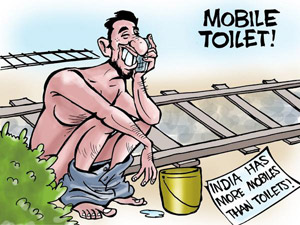
It is estimated that more than 1 billion people worldwide defecate in the open every day. A staggering 620 million of them are Indians. In a world of instant communication, space travel, nuclear weapons and bio-engineering this is a shocking statistic. More Indians own a mobile phone than use a toilet. Many choose to defecate at night to avoid the indignity of possibly being seen squatting to relive themselves during daylight hours. Fatally, this was the case for the two Indian girls.

toilet

Sanitation brings many health benefits, such as reduced diarrhoea, reduced worm infestations and reduced stunting. In a survey of readers of the British Medical Journal in 2007, sanitation was voted as the single most important medical milestone since 1840. Sanitation also brings dignity, it saves time, and it reduces the risk of being of attacked or assaulted, as happened in Uttar Pradesh. The solution to this challenge may seem simple: build toilets for everyone. It should not even cost that much in the scheme of things. However, past projects that did just that failed. High quality toilets were constructed for households but many were never used for their intended purpose; they were used to store firewood or house livestock instead. Essentially, this was because they were provided via top-down initiatives based on ‘educating’ and ‘instructing’ households and communities to use toilets.

In recent years there has been a revolution in the sanitation world, namely Community-Led Total Sanitation (CLTS), which has put the power of development in people’s hands. Now they do not need to wait for charities or governments to come and build toilets for them (many of which they probably would not use anyway), they are enabled to truly understand the importance of sanitation and the fact that they can do something to improve their living conditions by themselves. Subsequently, people who have spent a proportion of every day of their lives shitting behind bushes and shrubs are now building and using their own toilets without financial support. This is not about hand-outs but hand-ups. CLTS is an innovative, imaginative approach which targets emotions rather than intellect. Not only does it enable households to build their own toilets, it also truly empowers them and builds self dependence (see: http://www.cltsfoundation.org/ for more information).

Dr. Kamal Kar, the creator of CLTS, and included in Foreign Policy Magazine’s list of Top 100 Global Thinkers, once told me over a drink (in his typical flamboyant style) that it is the ‘intellectual constipation’ of governments and sector professionals that is holding back this sanitation revolution. Many governments simply do not appreciate the importance of sanitation and its far-reaching effects. Compared to high-tech sectors such as communications, industry and defence, sanitation is just not sexy! However, thanks to the momentum that has been created since the International Year of Sanitation in 2008, sanitation is beginning to receive the attention it deserves. CLTS is now implemented in more than 50 countries worldwide. Interestingly, one of the countries in which CLTS has not been adopted at scale is Kamal’s home country, where half the world’s open defecators reside: India. Perhaps is it true that ‘no prophet is accepted in his own country’. But even here, the shortcomings of the well-intended but misfiring government Total Sanitation Campaign (which some experts have claimed is ‘doomed to fail’) provide an opportunity to get rid of the ‘intellectual constipation’ that leads to top-down and ineffective solutions. Gradually, I believe, we are administering the required laxative.

In my opinion, technology-based solutions such as the Reinvent the Toilet Challenge funded by the Bill and Melinda Gates Foundation are misplaced. It is not technology that will solve the problem but a change in social and cultural norms, which CLTS aims to achieve. Most toilets constructed under CLTS programmes are low-cost, simple facilities located outside the house or dwelling. This is the first step to stop people from defecating in the open. Even in developed nations, where sanitation has had far-reaching impacts on health and well-being over the past century or so, toilets inside the house are still a relatively new development. I recall using an outside toilet at playschool when 3 or 4 years old, and my father tells the story of hearing his young neighbour shout “I need attention!” whenever she had finished her business in the outhouse.

Those unfortunate girls in Uttar Pradesh were not looking for attention at all. All they needed was a toilet.

Charity: Doing good or feeling good?

It is in giving that we receive.

I have just returned home from Burundi where I encountered a rather strange Belgian woman working for a local charity. We met at a health centre high in the hills south of Bujumbura, hemmed in by steep terraced slopes dotted with tin-roofed dwellings and lonely patches of trees. I extended my hand and greeted her in my best schoolboy French: ‘Bonjour. Je m’appelle Pete.’ She took my hand in a limp, damp handshake without uttering a word. The nun in charge of the health centre welcomed us all and explained the challenges they faced concerning inadequate water supplies, her flowing white habit flapping in the wind. A schoolgirl of 10 or 11 described her daily routine of walking a round trip of 4 kilometres to collect water, unaware of the incongruity of Justin Bieber smirking up from her soiled t-shirt. The nameless Belgian was a tall, broad women who seemed as uncomfortable in her frame as she was with other people. She listened to the conversations unsmiling, showing no reaction, all the time clutching a large plastic bag to her chest. Once inside the health centre she began to surreptitiously extract items from the bag and hand them one-by-one to the nun: several pairs of plastic slippers; some bandages; a packet of pills. The nun received them graciously, expressing her gratitude.

Before leaving, the woman approached the huddle of children outside the health centre to hand them some sweets. They jumped up and down laughing and screaming, trying to grab the precious parcels of pleasure. At once, the woman’s face lit up – as if someone had flicked a switch. She ran to the vehicle to fetch her camera, all the time beaming. She returned, her smile wider than ever, transformed: almost reborn. Although I’m sure that the gifts were genuinely appreciated, I couldn’t help wondering who had received more. The entire contents of the bag could not have cost her more than $20.

This experience reminded me of another encounter a few years ago with an American school teacher in South Africa. We happened to be visiting a rural school in Guateng at the same time and she was there with various hand-outs for the children: Kansas City baseball caps, t-shirts and sweets. She ran around the schoolyard with the children, frenzied, screaming, so happy she was out of control, as if high on drugs or alcohol. She then read letters from schoolchildren in Missouri (or somewhere equally parochial) sending their best wishes and hoping their African counterparts would like their gifts. The South African children then read their own letters expressing thanks to those far-off benefactors, no doubt busy on their PlayStations and iPads as those humble children spoke their heartfelt words. I couldn’t help but feel uneasy. Why should a child in Africa feel the need to be grateful to a child in the US or the UK or Japan? Is this not as much about power as trade barriers and wars for oil? And who is the real beneficiary (a word I detest in development language) here? It seems to me that these charitable souls are receiving far more than they’re giving. That’s not to say that what they are doing is necessarily wrong but we should disabuse ourselves of the notion that it is only one party doing the giving.


The Challenge                                                                                                                

The day after encountering the enigmatic Belgian I found myself in an IDP (internally displaced person) camp surrounded by 20 or 30 children, all trying to hold hands with, or feel the skin of, the strange Muzungu (‘white man’ in Kiswahili). Among them was a young girl who refused to let go of my hand and bounced up and down beaming at me, seeming oblivious to the bigger children jostling for space around her. She must have been about 3 years old and yet she was shorter than my own son who is not yet 18 months. Burundi is rated worst on the Global Food Security Index and has one of the highest stunting rates in the world, with over 50% of children under five being stunted (low height for age) as a result of malnutrition.

The people in the camp were accommodated there when their homes were destroyed by floods and landslides in February this year.  They were living in basic tents provided by aid agencies. I pulled aside the flap of one tent and peered inside. There was nothing except a pile of blankets and a few items of clothing: no possessions; no gadgets; no toys. Most of the camp residents were reluctant to go home. Why should they, when they had no house; no land; no hope? Aid agencies provide essential services in the camp such as shelter, water, sanitation and food for the under-fives, but what can charity do to improve their lives in the long term? Not a lot, perhaps.


I don’t believe in charity.                                                                                                  

In general, I don’t believe in charity. It creates dependency and obligation and is built on unequal power relationships. That might strange coming from someone who has worked in international development and humanitarian relief, in one capacity or another, for 20 odd years (some of them very odd!). There are two exceptions, however. The first is in an emergency situation, such as the camp described above, following a flood, earthquake or conflict. I have worked for two charities – Médecins Sans Frontières and Oxfam – and in both instances I worked in emergency settings, providing water and sanitation to refugees or populations affected by disasters.

The second exception to my ‘I don’t believe in charity’ rule is more complex. This is where services which could, or should, be provided by the government or society (although of course there is no such thing according to Margaret Thatcher) are not and charities fill the gap. This happens in developed countries as well as less-developed ones. For example, regional air ambulance services and the Royal National Lifeboat Institution in the UK are registered charities. Although even here it could be argued that Government should provide these services, for me, the critical issue is when the services that should be provided are the most basic: water, sanitation, education and healthcare. Supporters of charities will no doubt argue: ‘But governments are not providing these services so we have to!’ This may be true in some cases but governments definitely should be providing them and charity may even prevent them from doing so, as it allows them to abrogate responsibility to someone else.


Charitable foundations                                                                                                    

Of course, the current big thing in the charity world is ‘The Foundation’. There is now a plethora of foundations established by corporations, public figures and celebrities to help those less fortunate than themselves. All noble acts no doubt. But while I’m sure that all these businesses and individuals are genuine in their desire to help others (after all, it makes us feel good doesn’t it?) and they may even do some good for some people, one can’t help but wonder whether there’s often a bit too much ego involved and if it’s more about PR than anything else. Individual billionaires and multi-millionaires collectively commit billions of dollars every year to charitable foundations for good causes, including support to the poorest countries in the world. ‘This is good news, surely?’ I hear you protest. Well, yes it is. But then again, when you have several billion dollars a few billion more or less probably doesn’t make a whole lot of difference. The key question here is: why do individuals and corporations have so much more money than entire countries in first place? (The 85 richest people in the world have as much wealth as the 3.5 billion poorest.) And what makes rich people more qualified to make development decisions than governments, development agencies or communities themselves?

Warren Buffett, once the richest man on the world and still in the top four, is arguably the biggest giver to charity, having pledged more than $30 billion to the Bill and Melinda Gates Foundation alone (kudos to Mr. Buffett that he decided to give much of his wealth to a foundation other than his own). How did he make his money? By moving money around. Some will argue (and have to me) that he has lent money to business ventures that have developed innovative technologies, some of which have saved lives. Perhaps. But the fact is that he has made his vast fortune by moving money here and then there, and here and then there, without directly producing anything tangibly useful to society (which I do believe exists, contrary to Thatcher’s claim). A highly intelligent man, no doubt; but in making his money has he really worked so much harder or contributed more to society than the subsistence farmer or coal miner who toils day-in day-out for so little reward? This is no criticism of him as an individual. He appears to be a modest man and is clearly committed to helping those less fortunate than himself, to the extent that he has stated that his children will not inherit a significant proportion of his wealth, which will go to charity instead. It is, however, a criticism of the system that allowed him to amass the wealth he has.


The Solution                                                                                                                      

The only true solution is a more equitable and just world built on a more equitable and just economic system. Note that I say ‘more’ equitable and just. I am not so naive as to believe we will all have exactly the same opportunities and same assets. Even communism failed on that one. But I am convinced that we can have a much more equitable state of affairs. This means true fair trade (not just a stamp on a packet of tea) whereby a fair price is paid for raw materials, which are – sometimes literally – the lungs of our planet. It means more respect and more value for natural resources, less materialism and less waste (the millions of plastic bottles discarded every day are sought after possessions in rural Burundi). It also means effective taxation and wealth distribution. The profit incentive for businesses need not be removed completely but social, ethical and environmental factors must come first, and taxes should meet all basic requirements for all citizens. The priority should be economic equity (not equality) rather than economic growth. For this to work, true accountability of leaders is also needed; not just through the ballot box, which has its own limitations, but through international mechanisms to ensure that states deliver basic social services. The International Criminal Court (ICC) should not just focus on war crimes but on economic crimes (such as those of leaders who fill their pockets while their compatriots struggle in extreme poverty) which can be just as horrific and last far longer.

Unless we have sweeping economic (and political) reform, what hope is there for that little girl in the IDP camp? Can charity enable her to hope for similar opportunities as I hope for my own son? And yet, I believe wholeheartedly that she should. This will mean ‘sacrifice’ for my son, but only in terms of less possessions, less consumerism and less extravagance. And I have no doubt that he would agree happily to this if given the facts young enough and sensitized to the destructive power of commercial materialism and corporate power. It is the fear of loss that maintains the status quo.

Charities will continue to do their work, as will international development agencies, but simultaneously we must go beyond this and push for revolution of the global economic system and power dynamics. With new information technologies and an increasing disconnect between real people and the established powers (corporate and governmental), the future must belong to the crowds. Relying on charity is like placing a band aid on a severed limb; it may stem the flow here and there, but we remain incomplete, lacking our essential humanity.